
reportager

news
This section will include forthcoming exhibitions, reviews, projects and other news relating to visual essay and documentary illustration, some of which may be generated by reportager.org. Material will be added to this section as it becomes available.
Reportager Award
Reportager will in due course, be announcing a call for submissions for the ‘Reportager Award’. The award will be for work the jury considers to be the most outstanding in the area of documentary illustration, drawn reportage and visual essay. The award will be open to all artists at all stages of their career from student to established. Further details and more information to be Announced.
top
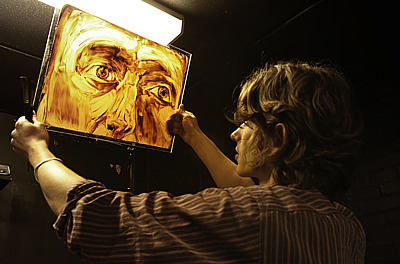
| Animating with oil paint George Sander Jackson’s work on the Graham Chapman biopic 'A Liar's Autobiography' For this project George animated a section for the film biopic 'A Liar's Autobiography' on the life of Graham Chapman in which he tries to dry out from his alcohol addiction - Chapman was at this stage drinking 3 pints of gin a day. Sander Jackson’s successful pitch for this feature film was based on the 'ink on glass' animation ‘No-one is illegal‘ featured on 'Reportager'. “I wanted to use this murky, morphing imagery to capture the claustrophobia and gnawing agitation described by Graham in recounting the '3 days of hell' it took him to break his addiction. The challenge on this occasion was for the final footage to be suitable for cinematic display and also to then be translated into Stereoscopic 3D - something never previously attempted through the medium of 'ink on glass' animation. The challenge for me was capturing the emotions and expressions of a man who had been dead for 23 years. Through countless viewings of interviews with Graham, in particular the famous 'Parkinson' episode in which he admitted to his drink problems publicly for the first time. I familiarized myself which each facial tic, agonized eyebrow and assiduous smirk. Working away for 3 months in a small dark room in UWE's media center, with a Perspex sheet placed over a light box under a rostrum camera, I painted each frame of raw footage in thinned oils. With the magic of After Effects and some help from the talented Lottie Kingslake at ArthurCox, this imagery was layered up, looped and brought to life in a strange, cut-out throbbing 3D world of paranoia and hallucination. Seeing the final footage in the context of the full film, alongside 15 different styles of animation, brought to life with an equally disturbed soundtrack, was a great culmination of this exciting project. The film was premiered at the London Film Festival on 16th October, and will go on general release in the UK in January 2013 (November 2012 in the US). Further information:  Adobe
making of documentary Official
movie trailer Project
Chapman 3D Adobe
making of documentary Official
movie trailer Project
Chapman 3D top |
  |
| Book Review The Fundamentals of Illustration (Second Edition) by Lawrence Zeegen; Louise Fenton Published August 1st 2012 Publisher: AVA Publishing £26.50 The Fundamentals of Illustration 2nd edition is pretty much the same book as the first edition but re-designed and re-arranged in a new order with bigger type, bigger images and more space. There are some great new examples of illustration such as the case studies by reportage illustrators Olivier Kugler, Ben Kelly, Tim Vyner, and Howard Read amongst others but the book feels 'image light'. In fact there are 50% less images in this new edition, (approx. 123 to the previous 253) although the page count remains much the same. At the end of each section there is a ‘Try it yourself’ section and ‘Questions in summary’ which seem to be a little lost on the colourful but empty pages which are crying out for more images. These sections make the book feel a little 'text bookish' and aimed more at ‘A’ level students still undecided as to their HE level subject choice. In fact, for Foundation students and possibly students at the beginning of their degree studies, it’s an ideal introduction to the discipline with loads of good advice on the different areas within the industry. The previously useful section showing examples of invoices, information on ownership and copyright is unfortunately missing, although there is an extra section on ‘working with ethics’, which is helpful. The self-initiated section could have been explored more fully with a wider range of work, re-defining the discipline. There is a real interest in the Graphic novel genre with some inspiring and innovative developments, as well as narrative illustration and self-publishing, both of which are under represented in the book. Over all, I would have liked to have seen more diverse examples of current, contemporary illustration. Many images from the previous edition while still relevant, have been omitted - and yet others have been kept which are less so. In terms of the general feel, the book doesn’t have the visual impact or excitement of the first edition. I would however, still recommend this book which is full of useful information for the budding illustrator. www.avabooks.com/books/details/the-fundamentals-of-illustration-second-edition
GE top |
 |
| Wacom Inkling
digital pen review Field tests by Gary Embury and Dave Sparshot Gary Embury There is an apocryphal story regarding the development of a space pen by NASA. At the height of the space race millions of pounds were supposedly spent to develop an anti gravity pen. The Soviets solved the conundrum by handing their Cosmonauts pencils. The Inkling is an impressively slick James bond of a drawing implement. It comes in a matt black case which opens up to reveal a digital bulldog clip, a USB cable, four needle slim gold biro style cartridge nibs and a chunky black pen which is cunningly concealed within the case. After charging up for three hours the pen is ready for use. The line quality is as you’d expect from a biro type pen and if you don’t like it you can alter the line size and quality picked up by the receiver. Unfortunately it wont change the line on the paper or the fact that at speed the ink flow couldn’t keep up with my furious on the spot scribbling. Once downloaded, the drawing, if you’ve remembered to press the button on the clip, comes in on layers. This is quite a good feature as it encourages the user into making work which is less precious. The artist is aware the original drawing is partly redundant or at least secondary to the digital version. The digital version however is different to the original in the fact that at times the pen fails to record certain lines and at other times offsets or mis-registers the layers. I quite liked this feature as it led to some interesting results. On the whole I feel it’s a tool I want to investigate further even if it’s in order to subvert. There are features I haven’t had chance to investigate as yet such as the different line qualities which take advantage of the pressure sensitive nib. On the spot drawing probably isn’t the best environment for the Inkling but for studio design work which is then immediately digitally editable I’m sure it’s a winner. Dave Sparshot Turning on and setting up the inkling pen and clip-on receiver is really easy and takes no time at all. The first issue however is that the pen only has a biro style nib making it quite unpleasant to draw with if like me you are more comfortable drawing with graphite. Drawing on location as a result feels a bit unnatural and scratchy. Looking at the resulting inkling drawings when compared to the originals, it appears that quite a bit of detail has been missed (see image, right) the line has seemingly jumped around in certain areas. I suspect that this is due to using the inkling whilst drawing outdoors on a sketchbook that is held at an angle with interference between the pen and the receiver. I imagine the inkling would be a really useful tool when used by designers as a way to quickly digitize and share ideas. However for an illustrator and especially one working on location it's not particularly practical as a way of creating accurate reproductions. Perhaps if there was a wider choice of nibs which provided better feedback whilst drawing then it may have a wider appeal. top |
 |
| Sue Coe :
'Cruel' (09.05.12) Sue Coe's new book 'Cruel' sub titled 'bearing witness to animal exploitation' has just been launched at Mooshoes in New York in conjunction with "Mad As Hell" an exhibition of her work at Galerie St. Etienne, 24 West 57th Street New York. The exhibition runs until July 3rd. The exhibition includes new work and some classics including selected art from the new book. Sue's book, an illustrated indictment of what humankind is doing to the rest of the animal nations, includes essays by Sue, "country fair" "pecked to death" and "Gassing Hogs" amongst others. The book is published by OR Books
www.orbooks.com/catalog/cruel/
I met up with Sue Coe in New York at the book signing where I spoke to her about reportage and visual essay. Sue confirmed she will be joining reportager and showing visual essay work in the projects section soon. An interview with Sue Coe about her new book 'Cruel' by Steven Heller.
www.printmag.com/Article/Witness-to-Slaughter
top |
  |
| Dave Sparshott’s
South East Asia sketches (21.04.12) Dave Sparshott has recently returned from travelling for six weeks through South east Asia, documenting his experiences through location drawing. His primary focus has been upon documenting the places, people, and journeys he experienced whilst backpacking through Vietnam, Cambodia, and Laos. The images here are a small example of his sketchbook work made on location and which he intends to use as material for an extensive, self-published illustrated travel journal or guide with drawn maps and annotations. Find out about and see more of Dave Sparshott's work on his member's page, or by visiting his previous travel documentary work in his Visual Journal in the projects section of Reportager. top |
  |
| Working Drawings
(01.03.12) Working Drawings brings together international designers, image makers and visual communicators to investigate drawing practice as part of a methodology for articulating and exploring thoughts, ideas and concepts. Whether a pictogram that transcends words, a visualisation of topography, an emotional response to language or as a formal means of communication, the drawings gathered offer a rare insight into the various stages of the visual communication process and an opportunity to analyse how the influence of drawing practice has historically informed design practitioners. Gallery Talk: Tuesday 03 April, 13:00 - 14:00 Naomi Games, daughter of internationally renowned designer Abram Games, discusses his preliminary sketches included in the exhibition; offering an insight into his working methods and how he progressed initial ideas to final images. London Gallery West, University of Westminster, Watford Road, Harrow, Middlesex HA1 3TP  +44 (0)20
7911 5970 +44 (0)20
7911 5970  a.leeman@westminster.ac.uk www.westminster.ac.uk/london-gallery-west a.leeman@westminster.ac.uk www.westminster.ac.uk/london-gallery-westtop |
 |
| Matthias
Beckman: Artists Studios in Berlin (25.02.12) On June 15, 2012, Matthias Beckman's series "Artists Studios in Berlin" will be exhibited at Columbus Art Foundation in Ravensburg (Southern Germany). The Columbus Art Foundation intend to publish a catalogue with text by Andreas Schalhorn, curator of the Kupferstichkabinett Berlin (Collection of drawings and prints). In November 2012 the exhibition will be shown at Fruehsorge Contemporary Drawings in Berlin. Other venues to be announced. Matthias Beckman's series about Vietnamese Life will be exhibited at the Museum of Asian Art in Berlin in 2013. There already exists a booklet of drawings published by the artists residency programme "Lichtenberg Studios", curated by Uwe Jonas. top |
 |
| Built
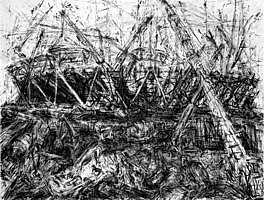
(16.02.12) Joining the Brickies, Chippies and Sparks each morning the Artists in this exhibition have all been Artist in Residence on many of the major public building works over the last few years. The Olympic Stadium, Tate Modern, Eden Project, Art & Design Academy in Liverpool and Glasgow’s new Riverside museum have all had Artists on site to observe and respond to the construction process. The Artists showing in ‘Built’ were granted access to view first hand the process of change as old buildings were brought down and new ones built. The work on display is an interrogation of the activity of construction as the artists got to grips with issues of scale and structure. Over the past three years Jeanette Barnes has produced numerous large drawings in response to the construction of buildings for the London 2012 Olympics. These along with other drawings that document the city of London under construction, explore through evolutionary layers of instinctive activity, the development and growth of the urban environment. Her work captures the energy and activity of the city and many moments of her experience of being there. The resultant images appear to constantly shift in search of something as yet unknown. Anthony Eyton was resident on site in 1997 as the Tate Modern emerged from the Bankside Power Station and as a derelict Bodelva pit in Cornwall was transformed by the Eden Project from 1999 to 2008. His focus is the connection he forms with his subject matter and what he describes as ‘trying to get the last ounce of myself to register [the experience]’. Whether rural or urban, his eye is drawn equally to natural and constructed growth. Julia Midgley was the DLA Piper Artist in Residence for the new Art & Design Academy in Liverpool designed by Rick Mather for Liverpool John Moores University. She describes drawing from direct observation as being the bedrock of her working practice and strives to produce a sense of live action work by which to document 21st century life. Her works on paper serve simultaneously as narrative, documentary and archive. Patricia Cain worked on-site from 2008 to 2011 as Glasgow’s new Riverside museum was constructed on the banks of the Clyde. Through initial observational work, she began to learn about the processes she was recording and the relationships between the contractors involved. Rather than looking at the building as an artefact, her work expresses the essence of the site and the historical character of the change that comes about from deconstruction and re-construction by reference to the nature of construction process. Cain curates this show. Mall Galleries, The Mall (near Trafalgar Square) London SW1Y 25 June - 7 July 2012 Times: 10:00 - 17:00 (closes 15:00 on final day) Admission: Free 020 7930
6844For more information and images contact: Liberty Rowley, Marketing & Press Officer 020 7968
0955 press@mallgalleries.com info@mallgalleries.com
www.mallgalleries.org.uktop |
|
|||||||||||||||||||


| Invisible Airs
(02.02.12) The computerized database is fundamentally changing society. From communication, to government, transport, shopping, friendship, health, education, narrative and even the way we watch film, the database is radically transforming our lives. And yet we are only barely aware of its existence, we don't really know what a database is : like electricity, it's pervasive and all around us , but we cannot actually see it. Digital media artists YOHA set about making the database visible. Working with Bristol City Council in England, they use local government expenditure to explore the relationship between the database, power and expenditure. Turning the pounds sterling of expenditure into the pounds per square inch of pneumatic pressure, they make a suite of engineered mechanical contraptions: a Potato Cannon, an Old People Pneumatic Floor Polisher, an Expenditure Riding Saddle and a Library Book Stabber. But as they tour these contraptions around Bristol, they become embroiled in the more visceral realities of the city, in the form of the Royal Wedding, local anti Tesco riots and the censorship of a local outdoor cinema. Invisible Airs is very much a story of our time, of our obsessions with the virtual world and its uneasy relationship to the physical world that we actually inhabit.
http://vimeo.com/36567631top |
 |
| Seven Thirty Eight
(23.01.12) Steven Wilkin, Course leader in Illustration at UCLAN has been drawing his fellow commuters on his daily journey between Hebden Bridge and Preston over the last ten years. It has become a fundamental part of his drawing practice over the last five years. He has collected over twenty sketchbooks of drawings. Last week Steven published a newspaper called ‘seventhirtyeight’ a tabloid that records over seventy of these commuter drawings. “It is effectively a travelling exhibition. I handed out the paper on my commute to my fellow passengers”. The newspaper also made an appearance at the International Drawing Project You can see the on-going record of the project on his blog.
http://seventhirtyeight.blogspot.com
www.newspaperclub.com/stevewilkin/newspapers/11828-seventhirtyeighttop |
  |
| International Comic Journalism
Book and Exhibition (17.01.12) Between 1998 and 2007 writer Pedro Rosa Mendes and photographer Wolf Böwig reported on the West African wars. Their work was published in leading magazines worldwide and nominated for the Pulitzer Prize in 2007. Now, they are joining 15 storytelling artists from all over the world merging writings and photographs with drawings - stories of daily life and survival during the wars in Liberia, Sierra Leone, Guinea Bissau and Ivory Coast. www.blacklightproject.org/project.phptop |
 |
| International Drawing Project
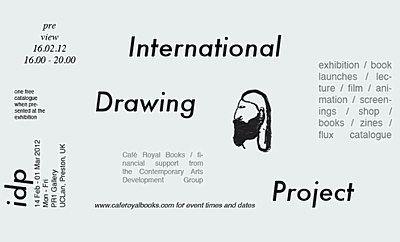
(05.01.12) 'International Drawing Project' - demonstrating the diversity and importance of drawing. Amongst the events will be an exhibition. The International Drawing Project launches next Thursday evening. 16.02.12, 16.30 - 20.00. At 17.00 Neil Morris, Reader in Contemporary Printmaking at Liverpool JMU will be presenting his work and discussing it in relation to drawing as a wider activity. The event will be held at the PR1 Gallery, Victoria Building, UCLan, Preston, UK There will be 100 free catalogues available during the launch evening. Café Royal Bookshop will be open, several book launches and film screenings. The exhibition will be in development untill it is removed from the gallery on March 2nd. 10 catalogues will be published durning the event to doccument it. The exhibition opens on 14.02.12 and runs till 01.03.12, 09.00 - 17.00 Monday - Friday. We hope to see you at the launch. |
 |
|
| Mike
Redmond and Faye
Coral Johnson will be artists in residence during the project,
using the gallery as their studio. There will be screenings and a drawing-based talk by an artist for whom drawing is central to their practise. There will be several book launches during the project. The events will be held at PR1 Gallery, UCLan, UK[ the same venue as last years pop-up library] and supported by the Contemporary Arts Development Group. February 13th - March 2nd. Preview February 16th TBC.
idp@caferoyalbooks.com www.caferoyalbooks.com www.caferoyalbooks.com/projects/international-drawing-project/top |
||
| Chronicle
Residency Programme (23.12.11) Topolski Studio ambition for 2012 and beyond is to host four young artistsnot in employment, education or training for six month Residencies. The Residency will offer them the opportunity to work together to produce, distribute and exhibit a monthly 'Chronicle', a cutting edge print publication of their own work responding directly to the work and methods of artist Feliks Topolski. Widely known as a war artist and chronicler of London's social and cultural scene, Topolski was the first artist to establish studios on the South Bank at the time of the Festival of Britain, where he reproduced over 2,300 drawings documenting leading figures and events of the Twentieth Century, on his own printing press as his broadsheet Chronicles. The Residents will be encouraged to be artistically innovative by using the Chronicle as an intervention in current trends and movements, particularly in the resurgent drawing movement, and to use print as a strategy for social and political engagement, chronicling contemporary issues of the twenty-first century just as Topolski did of the twentieth. The Chronicle will aim to be distributed widely in the local area, for example, being available for free in the receptions of local educational, community and cultural venues as well as establishing subscribers. The Residents will also gain an apprenticeship in the life of the new Topolski art and print studio. They will receive initial training in using the printing press and monthly master classes from different print and drawing professionals as well as on-going mentoring. The group will be professionally facilitated to design and deliver one workshop to the public during their residency and will host an exhibition and symposium based on the work they produce for members of the local and artistic community. |
 |
|
| Andrea Marie Education and Outreach Officer Topolski Century Gallery 150-152 Hungerford Bridge Concert Hall Approach Waterloo London SE1 8XU
020 7928 5433
www.topolskicentury.org.uktop |
||
| 1943 Auschwitz
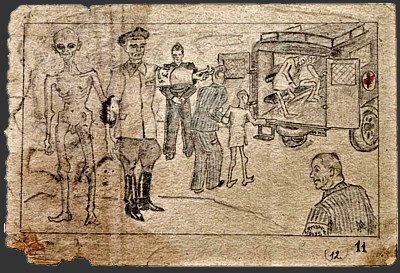
drawings : Secret Sketches (22.12.11) Sadistically laughing SS henchmen, frantic children, emaciated bodies on the way to the gas chambers: In his likely very shortened life, 'MM', an unknown inmate of the Auschwitz-Birkenau death camp secretly recorded what he or she saw of the Holocaust in 32 drawings on paper. Now, for the first time, the Auschwitz Museum has published the entire find. Red yellow flames issue from the twin high chimneys of the brick-built crematoria with the cynically homely latticed Windows. A man carelessly throws out wasted, naked bodies onto the loading area. Three bodies already lie in the dirt in front of the long, low building, where he will soon drop a fourth. In the foreground, turning away from the grotesque, stands a soldier in uniform, smoking - listless, with eyes closed and a petrified face, an SS Eagle emblazons his large cap. The letter "D" can be found under this yellowed pencil drawing with frayed edges, bottom right is the number 8. It is the eighth of a total of 32 postcard sized sketches, which document just a small segment of the mass murder in the death camp of Auschwitz-Birkenau. They were made by an inmate who directly witnessed the horror and risked his or her own life to secretly record them on paper. For the first time, the Auschwitz-Birkenau State Museum has issued the harrowing drawings as a book titled "An Auschwitz sketch pad" . The Unknown Artist "MM" The Museum staff have been as yet unable to figure out who was the unknown inmate behind the drawings. "The Artist remains a mystery," said spokesman Jarek Mensfelt. Very little is certain: the artist appears to have had the initials "MM" - at least these two letters appear on almost all the sketches. Inmate "MM" stuffed the 32 leaves in a bottle and hid them in the foundations of a barracks close to the gas chambers close to crematoria IV and V. They were found untouched by Józef Odi in 1947: an ex-prisoner himself who worked on the site of the former concentration camp as a security guard, living there until his death, helping build and mainain the Memorial site. The unknown artist rigourously recorded the inhumanities, most especially the orgainised killing on an industrial scale within the extermination camp. "MM", so the sketches illustrate, was animated by the desire to record the crimes of the Nazis in detail for posterity - and thus increased the mortal danger they themselves faced. It was strictly forbidden for the prisoners at Auschwitz-Birkenau to document anything they saw there. Other Nazi victims imprisoned in Auschwitz produced drawings of which about 2,000 surviving examples exist, but these were almost exclusively commissioned work for the SS staff: landscapes, portraits, greeting cards from Auschwitz, created in the vague hope of an additional bread ration. Only "MM" dared directly record the the appalling mass murder. This makes MM's sketches not only a unique historical source, but also a moment frozen in time, whose agonizing power can exceed that of the famous photographs of Auschwitz. With objective precision, the artist recorded all stages of the Holocaust: the arrival of the inmates disgorged for 'the selection', to the disengenuous routing to the gas chambers and the subsequent transformation of families and individuals into burning corpses in the waiting crematoria. 'MM' omitted nothing - writing down the license plates of the SS vehicles as well as the names of individual blocks, going to great efforts to work out the facial expression of the people involved. Traces of the millions of murdered We do not know when the artist made their last sketch. Unlike the rest, it has no number, the initials of "MM" are also missing. Only dimly, as if seen thrugh a fog can we make out the scene: men lift a body onto a truck, the outline of a house shows up in the background. The artist seems to have been interrupted as indicated by the unfinished nature of the sketch. Had something terrible happened to "MM"? Did they die? Get moved to another camp? In any case, 'MM' had enough time to take the pages from their sketch pad, put it in a bottle and bury it. There were also members of the so-called Sonderkommando in the Auschwitz-Birkenau extermination camp - Jewish prisoners, forced by the SS to do the leg-work, to be forever marked by the most psychologically cruel invention of the impersonal machinery of mass genocide. One of them was Salmén Gradowski, a Jew born in 1909 in the Polish Suwalki district. His diary notes, buried in the vicinity of Crematorium III began with the following words: "Dear Explorer, please search everywhere, search every inch of ground." Dozens of documents are buried here, mine and others who throw a light on what happened here. "In the hope that posterity will find traces of the millions of murdered." The sketches of "MM" are one such stunning example. The full article by Katja Iken in the original German can be found in 'Der Spiegel' edition of 20/01/2012 Translated from the German by Jan Gorski-Mescir top |
   |
| Dave Sparshott's South
East Asian Travelogue 2011-12
(19.12.11) Dave Sparshott is traveling for six weeks from mid-December 2011 to late january 2012 and will be documenting this through location drawing and retrospectively using photographic reference. His primary focus will be to document the places, people, and journeys that he will be experiencing whilst backpacking through Vietnam, Cambodia, and Laos. Upon his return he intends to produce an extensive self-published illustrated journal. The work which will consist of mainly drawings will be be exhibited in the Spring. I will be working in graphite and water colour pencil retaining a raw, sketchbook feel to the body of work. Hopefully this work will evolve whilst traveling and with a loose narrative running throughout. On a previous trip in late 2009 he produced a large illustrated map of South-East Asia. The body of work was produced whilst traveling and then reworked upon his return. Other reportage work that Dave has undertaken recently includes a commissioned series for the Times newspaper where he was sent to a weekly Premier League football match and then illustrated the match highlights, focusing on the dynamic between match build-up, the players, managers, and crowd. top back to current news page |
 |